
Ruentex Development Group has set forward-looking sustainability goals for 2030 and will continuously drive progress while reviewing achievements on an annual basis. Guided by three core values—“Value Integration,” “Low-Carbon Transformation,” and “Trust and Mutual Prosperity”—we align with the United Nations Sustainable Development Goals (SDGs) to further embed sustainability into the Group’s DNA, creating greater value and impact.
At the same time, we are committed to open dialogue and collaboration with external stakeholders, extending the reach of our sustainability strategy and working together with all partners to advance toward a virtuous cycle and a sustainable future.
Sustainable Management Framework
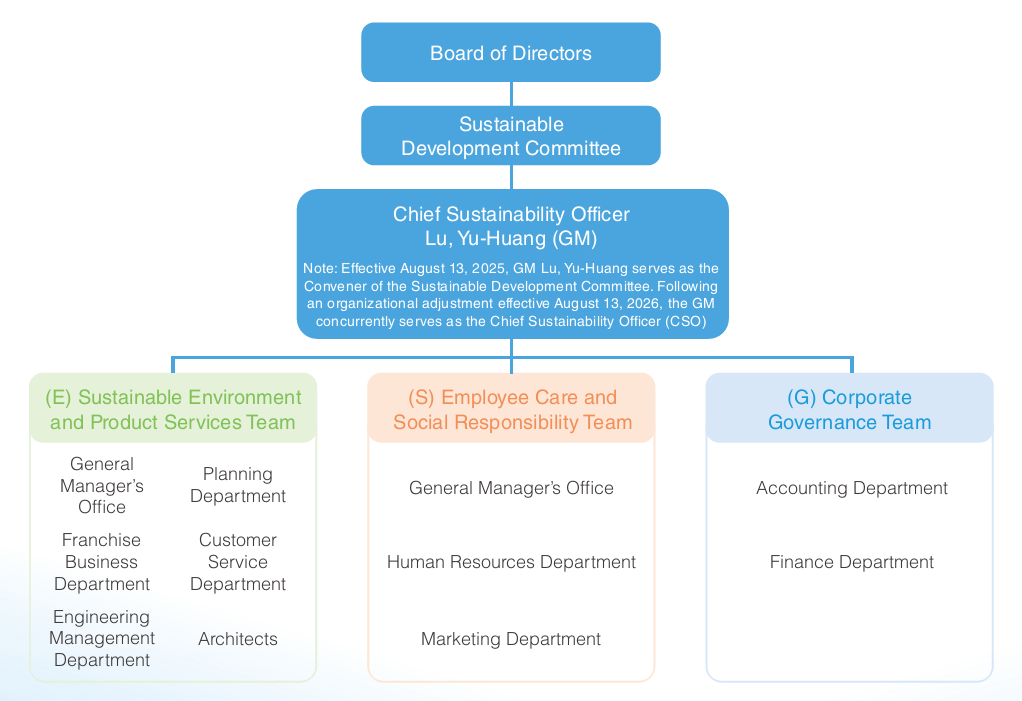
To strengthen the management mechanism for sustainable development,
Ruentex Development has established a Sustainable Development
Committee to oversee climate change-related issues, appointed a Chief
Sustainability Officer, and established a Sustainable Development Task
Force comprising dedicated and concurrent units to advance sustainable
development. The Committee is responsible for formulating and
implementing policies, systems, management guidelines, and specific
implementation plans related to sustainable development.
The Sustainable Development Task Force is convened by the Chief Sustainability Officer, with unit heads from the General Manager’s Office, Accounting Department, and other units serving as project team leaders, integrating cross-departmental units including the General Manager’s Office, Franchise Business Department, Engineering Management Department, Planning Department, Customer Service Department, Architects, Human Resources Department, Marketing Department, Accounting Department, and Finance Department. Based on their functions, they are divided into three major groups: “Sustainable Environment and Product Services,” “Employee Care and Social Care,” and “Corporate Governance,” working together to promote the company’s sustainable development goals. The assignment principle for project team members is based on evaluating and selecting whether their functions possess the capability to integrate resources and implement sustainability strategies, ensuring the effectiveness of committee operations.